
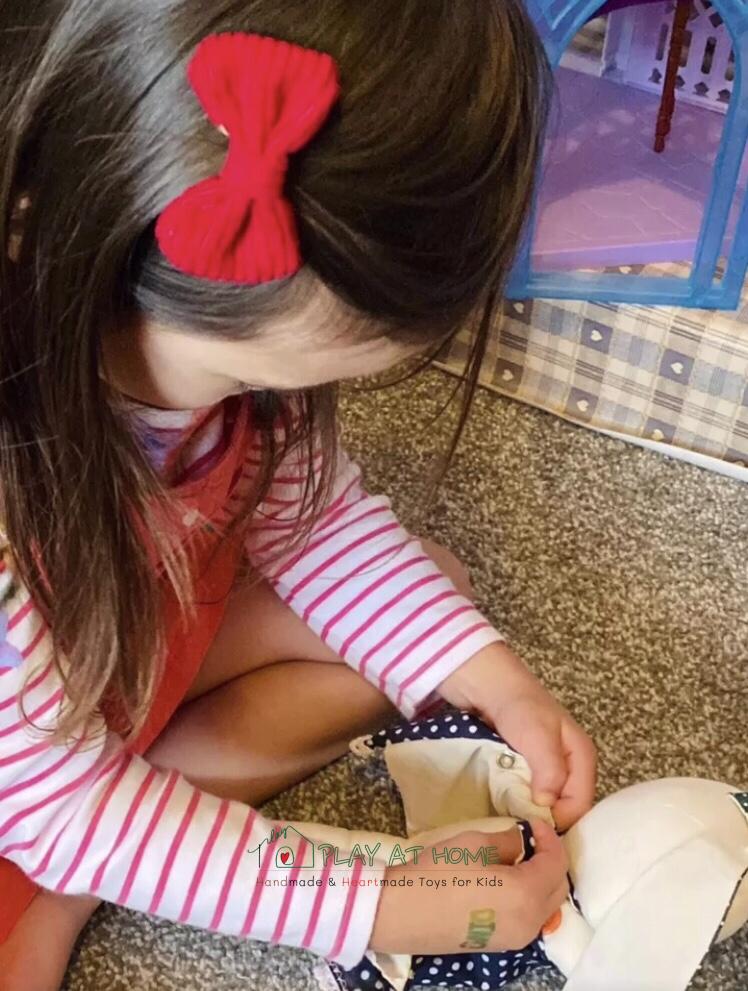
Children at Steiner preschools are always immersed in the activities of shoveling sand, rolling or tying wool ropes, stacking wooden blocks, folding fabric, watering plants, etc. Do children learn anything or develop anything from these activities? This simple?
The article below will clearly state the relationship between fine motor movements and the brain and the benefits of fine motor movements from research results in preschool and elementary schools.
Article written by Sebastian Suggate - Professor of Developmental Psychology and Early Childhood Education at Alanus University of Arts and Social Sciences, published in December 2014, at Erziehungskunst, Waldorf Education Today Magazine http ://www.erziehungskunst.de.
——————————————————————
Fine motor skills and sharp thinking. Findings from kindergartens and primary schools (Part 2)
Hands explore the world
Children with clumsy hands will be at a disadvantage in exploring the world. One might think that rapid and relatively constrained movements – for example, when playing computer games – do little to support cognitive development. Here, research by Martzog and others has shown that tasks that involve more complex fine motor skills (e.g., stringing beads) are strongly related to intelligence levels – while Fine motor skills that involve only repetitive and monotonous hand movements (“tapping”) do not affect intelligence levels.
Another area of great importance for both the development of thinking and for social integration is the development of vocabulary. Several studies have investigated the role of fine motor skills in vocabulary development. Then the complexity of the problem becomes clear. It looks as if fine motor skills are really important for word development, but most of all for words that are linked to sensory experiences. Therefore, even children with outstanding fine motor skills cannot quickly understand the meaning of abstract words like "belief". But words that indicate something that can be held or grasped with the hand, such as “belt” or “chair,” will be grasped more quickly by children with well-developed fine motor skills.
🧶How to support fine motor skills?
Unfortunately, we do not have many reliable scientific studies on this issue. However, there are support methods that have been applied for a long time in the field of education for children with special needs. From what has been said above, an increase in musical and craft activities seems logical. One early study asked parents about their children's play behavior and then tested their children's fine motor skills in kindergarten. Children who spend a lot of time at home doing things (watercolor painting, crayons, pasting) have significantly better fine motor skills.
The most difficult question to be answered in this context is: why should thought processes and word development actually depend on fine motor skills? The findings from the studies mentioned here do not support the view that children have better fine motor skills and intelligence because of an advantaged and privileged social environment (many of which stimulation and activities are more readily available).
🤲Map of the cerebral cortex that controls motor function
...
If we take into account Rudolf Steiner's research on the relationship between the brain, thinking and hands, then... human hands are not a purely utilitarian organ like in animals, but the hands are autonomous. due. Everything that the spirit can achieve can only be expressed through the hands – all culture and art are created with the hands. As for future developments, it would eventually mean that the hands themselves would be able to become a kind of organ of thought (lectures on June 8, 1912 and March 12, 1918). .
Translator: Thai Nguyen Hong Nhung
PlayatHome collects